The 5 Positive Millets: Which to Eat and How to Cook Them
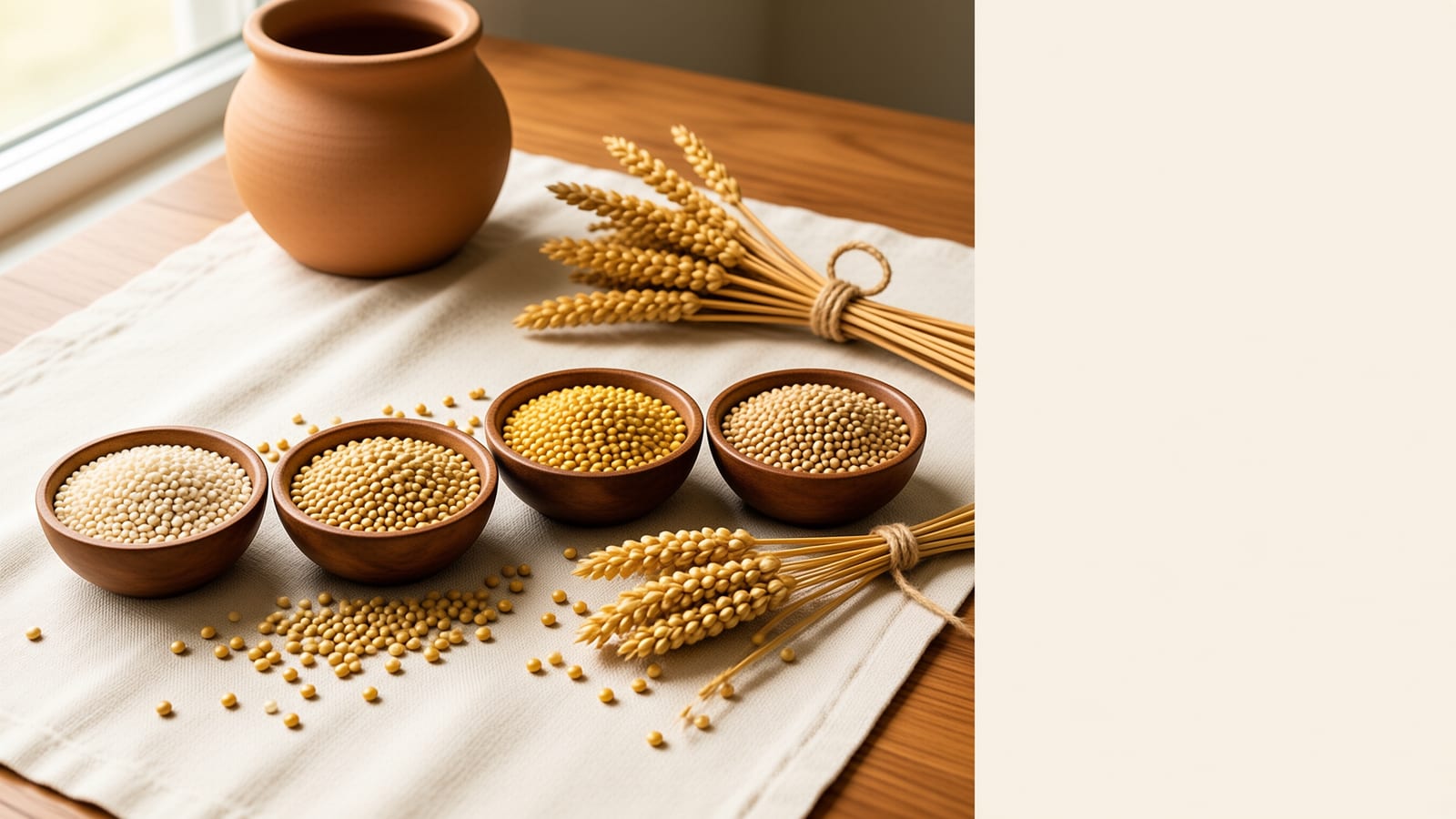
Dr. Khadar Vali calls foxtail, little, kodo, barnyard and browntop millet the positive five, and Daisy shows how she soaks, ferments and cooks them.
Key takeaways
- Dr. Khadar Vali calls foxtail, little, kodo, barnyard and browntop millet the positive millets, because he says they have 8 to 12.5% fibre.
- He calls ragi, jowar, bajra and proso neutral millets, with 1 to 4% fibre, and says they protect but do not reverse illness.
- Studies show millets have a lower glycaemic index than white rice or refined wheat, but they do not test the positive label.
- Daisy rotates one positive millet a day in her fermented ambuli drink, and uses barnyard for soft idlis.
- Wash millets very well and soak them for several hours before cooking.
- If you take medicine for diabetes, BP or thyroid, keep your doctor in the loop.
On this page (7 sections)
Millets are everywhere now, but the choice is confusing. Ragi, bajra, foxtail, kodo: which ones matter, and which should you cook at home? Dr. Khadar Vali, the Millet Man of India, sorts them into positive and neutral millets. Daisy credits his work for a large part of her own health journey. This guide explains the five positive millets and how she uses them.
What are the positive millets?
Millets are small, hardy grains grown across India for centuries. A 2026 review groups pearl, finger and sorghum as major millets. It lists proso, barnyard, foxtail, kodo and little millet among the minor ones.
The word “positive” comes from Dr. Vali. He uses it for five millets: foxtail, little, kodo, barnyard and browntop. He also calls them Siri Dhanya. It is his own grouping, not a standard nutrition term. Everything in this guide that rests on that grouping is his view.
Positive and neutral: the fibre story
Dr. Vali sorts millets by fibre. In his talk with Daisy, he gives these rough numbers.
- Foxtail: about 8%.
- Kodo: about 9%.
- Little millet: about 10%.
- Barnyard: about 10%.
- Browntop: about 12.5%.
- Neutral millets (ragi, jowar, proso, bajra): about 1 to 4%.
He says the fibre in positive millets is “mature”, so it releases glucose slowly. Neutral millets, he says, protect a healthy person but are not strong enough to reverse illness. Daisy agrees that ragi, jowar and bajra are nutritious but less therapeutic.
Which millet for what?
Here you need to be careful. Dr. Vali and Daisy name some uses. Research has not tested the five one by one.
- Little millet: Dr. Vali says it is the first grain fed to babies in tradition, and good for girls and hormone balance. He says it is the main millet in his thyroid protocol.
- Browntop: the highest fibre of the five. Daisy’s chart in her ambuli video marks it for thyroid health.
- Foxtail and browntop: Dr. Vali puts them at about 11 to 12 g of protein per 100 g, and says 100 g of any millet covers your protein dose.
- Barnyard: Daisy’s choice for soft idlis. She says foxtail or little millet also work.
- Kodo: none of her videos names a special use for it. It earns its place in the weekly rotation.
Daisy takes a different millet each day, because she says each feeds different gut bacteria. In her Ayurveda videos, she says the five suit kapha types, and she lived on them herself while losing weight.
How to cook the five millets
Daisy’s videos show a few ways. Millet is not hard to cook if you wash and soak it well.
- Wash very well. Daisy says millets can be dirty. Rinse until the water runs clear.
- Soak for hours. She soaks millet for her idlis for 7 to 8 hours and for ambuli for 8 hours. Soaking is also why her idlis come out soft.
- Ferment. Soaked millet can be cooked and fermented overnight as ambuli, or ground and fermented as idli batter.
- Keep it simple. In her weight loss video, Daisy uses millets in upma, cheela and khichdi, with more vegetables than grain.
Her ambuli is a watery fermented drink. She cooks one tablespoon of a positive millet in an unglazed mud pot, covers it with muslin and drinks it the next morning on an empty stomach.
For idli, she grinds soaked barnyard millet with whole urad dal and a little sabudana, and ferments the batter for 9 to 10 hours. Daisy has separate videos on millet ambuli, millet idli and millet paniyaram, each with full quantities and timings. Her paniyaram uses bajra, which is a neutral millet, so it is a lighter choice for the days you want variety.
Who should be careful
- If you take medicine for diabetes, BP or thyroid, keep your doctor in the loop. Your sugar may fall as you eat more millets, and doses may need to change.
- Daisy says some people feel bloated for 3 to 4 weeks as the gut adjusts. Start small.
- Dr. Vali says the claim that millets harm the thyroid is a misunderstanding. Still, if you have a thyroid condition, start under your doctor’s guidance.
- Millets do not replace a balanced diet. Dr. Vali’s strong claims about reversing illness are his view, and the studies above do not test them.
What research says
Research supports millets as a group. A 2021 review of 65 studies found that millets have a glycaemic index about 36% lower than milled rice and refined wheat. In people with diabetes, long-term millet eating lowered fasting and after-meal blood sugar. Foxtail and barnyard had the lowest glycaemic index in that review, while kodo and little millet were in the intermediate range.
A second 2021 review found that millet meals lowered cholesterol and blood pressure slightly. A large 2019 Lancet review of fibre and whole grains found lower risks of heart disease and type 2 diabetes in people who ate more of them. None of this tests the “positive” label itself, or the claims about reversing disease.
Daisy’s tips
- Buy whole, unpolished millets and wash them well.
- Rotate the five instead of eating one every day.
- Soak for several hours before cooking.
- Use more vegetables than grain at a meal.
- Start with small portions and give your gut a few weeks.
- Drink ambuli on an empty stomach, and skip tea or coffee straight after.
- Use a mud pot and a muslin cloth for ambuli, not steel or plastic, so air can pass.
- Eat when you are hungry and avoid snacking between meals, as she does.
Daisy shows how she uses these millets in the videos below.
Questions people ask
Which millets are the five positive millets?
Dr. Khadar Vali names foxtail, little, kodo, barnyard and browntop millet. He also calls them Siri Dhanya. The idea of positive and neutral millets is his own grouping, not a standard scientific term.
What is the difference between positive and neutral millets?
Dr. Vali says positive millets have about 8 to 12.5% fibre. Neutral millets such as ragi, jowar, bajra and proso have about 1 to 4%. He says only the positive five are strong enough to help reverse illness.
Do I need to soak millets?
Daisy washes millets very well because they can be dirty, then soaks them for several hours. She soaks the millet for her idlis for 7 to 8 hours and the millet for ambuli for 8 hours.
Can I eat the same millet every day?
Daisy rotates through the five. She says each millet feeds different gut bacteria, so a different one each day gives more variety.
Are millets safe with diabetes or thyroid medicine?
Millets are a food, not a replacement for medicine. Sugar can fall as you eat them, so your doctor may need to adjust doses. If you take medicine for diabetes, BP or thyroid, keep your doctor in the loop.
Further reading
- Anitha et al., 2021: millets for managing diabetes, systematic review and meta-analysis (Frontiers in Nutrition)
- Anitha et al., 2021: millets, blood fats, blood pressure and obesity, systematic review (Frontiers in Nutrition)
- Reynolds et al., 2019: carbohydrate quality, fibre and health (The Lancet)
- Borah et al., 2026: a review of millet types, nutrition and processing (Brazilian Journal of Biology)
This article shares Daisy's personal experience and traditional Ayurvedic knowledge for general information. It is not medical advice. Talk to your doctor before changing medicines or treating a health condition, and patch-test anything new on your skin. Read the full disclaimer.
Learn it with Daisy
New natural remedies and Ayurvedic rituals on her YouTube channel every week.


