Millet Ambuli: Daisy's Fermented Gut Drink Recipe

Prefer to watch? Open the full video on YouTube.
Daisy makes ambuli, a watery fermented drink of one positive millet, in a clay pot every night, and explains why she believes it heals the gut.
Key takeaways
- Ambuli is a watery fermented drink made from one of the five positive millets, not a thick porridge.
- Daisy rotates the millet daily, because she says each one feeds a different set of gut bacteria.
- It is cooked once, fermented overnight in an unglazed mud pot, and never heated again before drinking.
- Take it on an empty stomach, with no tea or coffee straight after.
- Skip oil, tadka, salt and vegetables during cooking and fermenting.
- If you take diabetes or thyroid medicine, tell your doctor before you start, as your dose may need adjusting.
Millet ambuli
You need
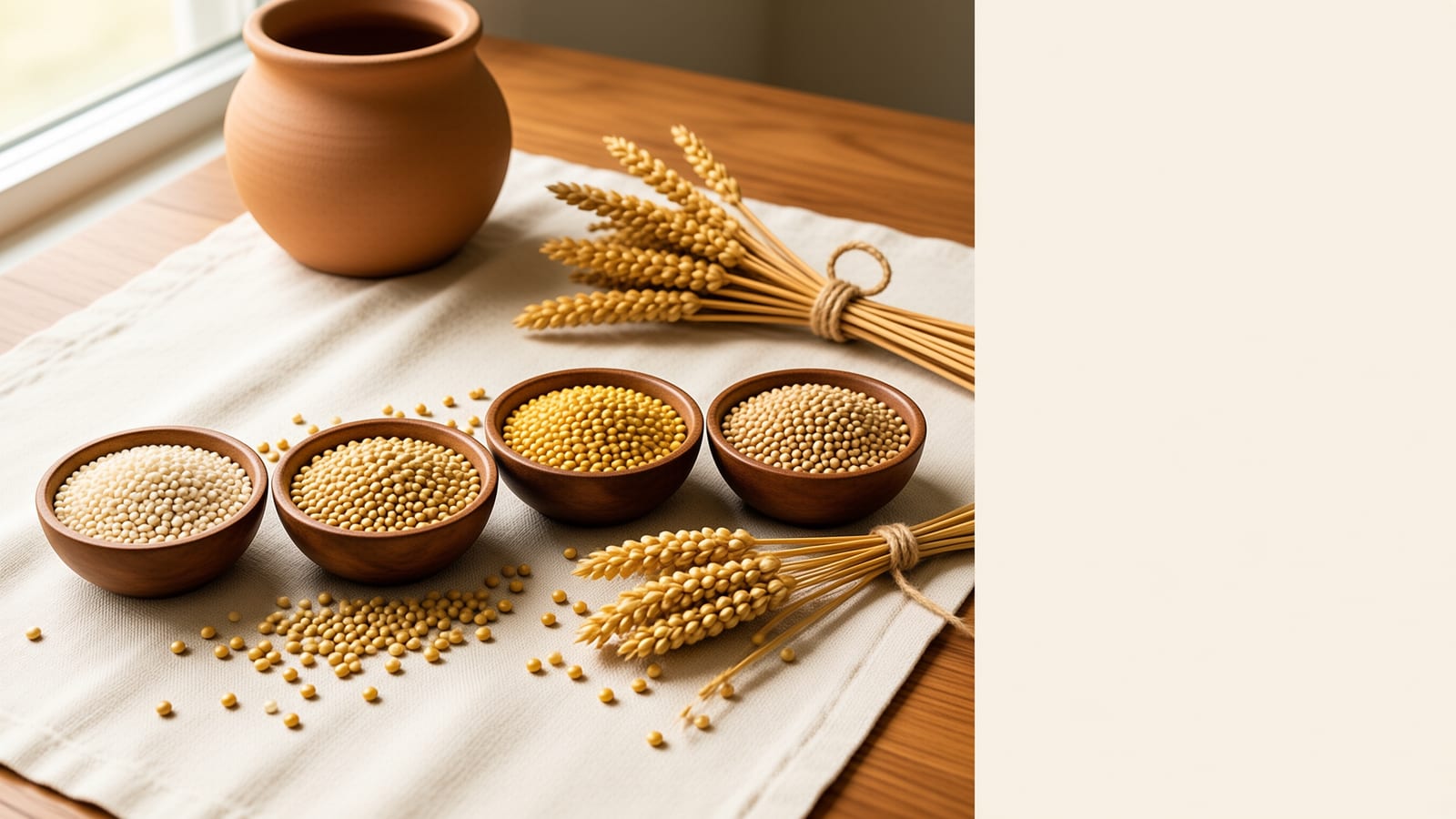
- 1 tablespoon of one positive millet (foxtail, little, kodo, barnyard or brown top)
- About 700 ml water (500 ml plus 200 ml), for soaking and cooking
- Freshly chopped coriander, to serve
- Black salt, to serve
- Roasted jeera (cumin) powder, to serve
Method
- Wash the millet very well in a strainer. Millets can be dirty.
- Soak it in 700 ml of water for 8 hours, covered.
- Cook it in an unglazed mud pot on a very low flame for 10 to 15 minutes, until the grains mash easily between your fingers.
- Let the pot cool completely.
- Cover with a cotton or muslin cloth, never plastic, and leave in a warm spot overnight.
- In the morning, stir in coriander, black salt and roasted jeera powder. Drink it as it is, without heating.
On this page (7 sections)
Many of us treat gut trouble, blood sugar swings and hormone problems as separate issues. Daisy believes most of them trace back to a weak gut. Her answer is ambuli, a fermented millet drink she has taken for years. It takes about 10 minutes of work, and the pot does the rest overnight.
Why Daisy focuses on the gut
Daisy says the gut is the one thing she works on, and the rest follows. In her view, nutrients such as protein and iron only help if the gut can absorb them. A weak gut, she says, makes the body sensitive to even simple foods.
She points to the work of Padmashri Dr. Khadar Vali, known as the millet man of India. She credits him for a major part of her weight loss and her energy. She quotes his words: “When your food is right, no medicine is needed. When your food is wrong, no medicine works.”
Daisy says people around the world have used his millet protocol, meaning ambuli, to reverse serious conditions. She reports this as what she has seen, not as a medical guarantee. If you take medicine for any of these conditions, keep your doctor in the loop.
Why millet ambuli, and not idli or rice kanji
Daisy loves idli, dosa and dhokla, and agrees they are good for the gut. The difference is cooking. When you steam an idli, the live bacteria die. You still get the by-products they made during fermentation, but not the bacteria.
Ambuli is never heated after it ferments. So Daisy says you get three things together:
- Prebiotic: the fibre in the millet, which feeds gut bacteria.
- Probiotic: the live bacteria that grew overnight.
- Postbiotic: the by-products those bacteria make, such as vitamins and acids.
Rice kanji and vegetable ferments are good too, she says, but the fibre is different. Rice is low in fibre. Vegetable fibre she calls immature. Millet fibre, she says, is a regulatory fibre that soaks up toxins, excess sugar and free radicals in the gut.
Daisy also says millets release glucose slowly over 6 to 8 hours, while rice does it within 20 to 30 minutes. That slow release, she says, avoids an insulin spike.
Which millets to use
Dr. Khadar Vali calls five millets “positive”: foxtail, little, kodo, barnyard and brown top. Daisy says they have between 8 and 12.5 percent fibre. She says jowar, bajra and ragi are nutritious but less therapeutic, because their fibre is lower.
Each day, she picks a different millet from a set of five. Her reason is that every millet adds its own bacteria, so rotating gives more variety. She also shows a chart in the video of which millet suits which condition. She notes that brown top targets thyroid health.
How to make it, and why the pot matters
Daisy soaks one tablespoon of millet in about 700 ml of water for 8 hours. She cooks it on the lowest flame, since a mud pot can crack on high heat. Once cool, she covers it with muslin and leaves it overnight.
The next morning it is still watery, and that is the point. Daisy says the thin texture lets the live bacteria survive the stomach acid and reach the gut. Do not turn it into a porridge.
She adds coriander, black salt and roasted jeera. She does not add oil or tadka, and she warns against adding salt or vegetables during cooking and fermenting.
On the pot, Daisy says an unglazed clay pot is porous, so it lets in a little air that the lactic acid bacteria need. Steel, aluminium or glass, she says, shifts the balance towards less useful bacteria. She has used her pot for about four years for fermenting, and says the taste is now the same each day. She advises washing it with salt, vinegar or hot water, or lime and salt if it is greasy.
What about vitamin B12?
Daisy is clear that ambuli does not contain B12. She says Dr. Khadar Vali teaches that a healthier gut may restore its own B12 production over time, which could help vegetarians. She adds that this is slow, not instant. She still takes a B12 supplement and plans to taper it later.
What research says
Daisy’s reasoning draws on tradition and Dr. Khadar Vali’s field experience. Research on millets is encouraging but still limited. A 2021 review pooled 65 human studies. It found that millets have a glycaemic index about 36 percent lower than milled rice and refined wheat. In people with diabetes, long-term millet eating lowered fasting glucose by about 12 percent and after-meal glucose by about 15 percent. The authors noted that many studies were small, only two involved prediabetic people, and some bias was likely. See the Frontiers in Nutrition review.
This research is about whole millets in meals, not about ambuli itself. For fermented foods, a small Stanford trial of healthy adults found that a high-fermented-food diet raised gut microbiome diversity and lowered markers of inflammation in a 17-week randomised study. A high-fibre diet did not raise diversity. The study had 18 people per group and did not test ambuli. See the Cell paper. We found no study that tests ambuli on disease reversal.
Daisy’s tips
- Drink it on an empty stomach. Daisy has hers after her amla drink and a 2-hour gap.
- Skip tea and coffee right after. She says milk, tea and coffee interfere.
- Never reheat it after fermenting, or you kill the live bacteria.
- Use a breathable cloth cover, not plastic.
- Wash the millet well before soaking.
- Give it time. If you feel bloated, Daisy says wait 3 to 4 weeks as your gut adapts.
- If you are on heavy diabetes medicine, expect your doctor to adjust doses as your sugar falls.
- If you have a severe thyroid condition, start under guidance.
- Try it for 2 to 3 months and watch how your body responds. Daisy says every body is different.
Daisy shows every step in the video above. It takes about 18 minutes.
Questions people ask
What is millet ambuli?
It is a watery fermented drink made by soaking, cooking and fermenting one millet overnight. Daisy says it is a traditional food in South India, and goes by different names in the north.
Which millets are used for ambuli?
Daisy uses the five positive millets named by Dr. Khadar Vali: foxtail, little, kodo, barnyard and brown top. She takes a different one each day.
Can I make ambuli in a steel vessel?
Daisy advises against it. She says an unglazed mud pot is porous, lets in a little air, and suits the bacteria she wants to grow.
Does ambuli contain vitamin B12?
Daisy says it does not contain B12 itself. She says Dr. Khadar Vali teaches that it rebuilds gut bacteria that help the body make its own B12, slowly. Daisy still takes a B12 supplement.
Who should be careful with ambuli?
Daisy says people on strong diabetes medicine should expect their doses to need adjusting. People with severe thyroid problems should start under guidance. Some people feel bloated for 3 to 4 weeks.
Further reading
This article shares Daisy's personal experience and traditional Ayurvedic knowledge for general information. It is not medical advice. Talk to your doctor before changing medicines or treating a health condition, and patch-test anything new on your skin. Read the full disclaimer.
Watch Daisy explain it
The full video shows every step, in about 19 minutes.